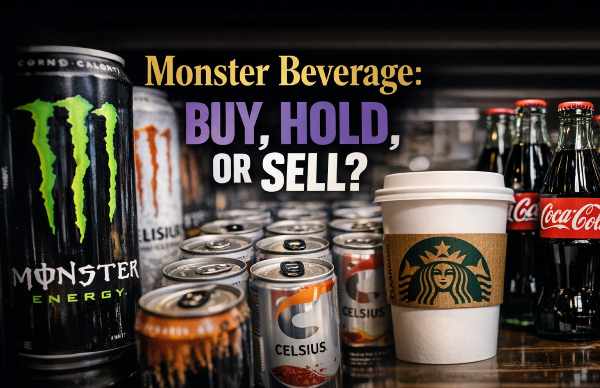
Monster Beverage used to be the dominant force in energy drinks. But with Celsius exploding in popularity, investors are asking the same question: Is Monster Beverage a buy right now? Let’s walk through the numbers, the story, and the reality
Price Action: A Strong Past, A Slower Present
Let’s start with what everyone looks at first: price action. Over the last year, Monster Beverage delivered a 32% CAGR, a massive gain for a mature beverage company. Zoom out to five years and the growth settles into a still‑healthy 11% CAGR. Growth has slowed, yes, but the legacy of huge returns keeps long‑term shareholders optimistic.
Market share is a big deal in food, beverage, and restaurant stocks. Monster Beverage sits in a strange but impressive position: it’s both the fourth‑largest and fourth‑smallest non‑alcoholic beverage company among its peers. And here’s the kicker—it’s nearly 10× larger than Celsius.
Market Share Snapshot
| Metric |
Value |
| Current Market Share |
0.93% |
| Market Share in 2021 |
0.76% |
| 5‑Year Market Share CAGR |
6% |
| Relative Size vs. Celsius |
~10× larger |
That steady upward trend in market share? Investors love that.
Fundamentals: High Margins and Big Revenue
Now let’s dig into the fundamentals. Monster Beverage’s gross margin sits at 55%, which is excellent. Energy drinks are one of the highest‑margin categories in the entire beverage industry.
Revenue has grown at a 10% CAGR over the last five years, reaching $7.66 billion. Growth has slowed, but the company still generates enormous revenue every year.
Cash flow tells an even better story. Operating cash flow increased at an 18% CAGR, while capex worsened at a 54% CAGR. Even with rising capex, free cash flow still grew at a 16% CAGR. This company prints cash—year after year.
Cash Flow & Revenue Breakdown
| Metric |
Value |
| Gross Margin |
55% |
| 5‑Year Revenue CAGR |
10% |
| Revenue Today |
$7.66B |
| Operating Cash Flow CAGR |
18% |
| Free Cash Flow CAGR |
16% |
Monster Beverage is a cash‑generating machine.
Share Buybacks: The Secret Behind the Stock’s Rise
What does Monster do with all that cash? They buy back shares—aggressively.
Weighted average shares outstanding dropped from 1.1 billion in 2021 to 982 million most recently. That’s a massive reduction. This is one of the real secrets behind Monster’s long‑term share price appreciation. Fewer shares + steady earnings = rising stock price.
Return on invested capital (ROIC) tells another part of the story. ROIC fell from 37.7% in 2021 to 28.4% most recently. Still good, but trending downward. Management is becoming slightly less efficient at turning capital into profit.
Efficiency & Capital Allocation
| Metric |
2021 |
Most Recent |
| Shares Outstanding |
1.1B |
982M |
| ROIC |
37.7% |
28.4% |
| Cash Conversion Cycle |
68 days |
89 days |
| Net Debt / EBITDA |
-1.7 |
-1 |
The cash conversion cycle is the one ugly spot—89 days, up from 68. Energy drink companies often struggle here, but Monster is still on the high end.
Balance Sheet Strength: More Cash Than Debt
Monster Beverage is profitable and has more cash than debt. Net debt to EBITDA moved from –1.7 to –1, but it’s still firmly negative. That means the company is sitting on a net cash position. For investors, that’s a comforting sign.
Now let’s compare Monster to the gold standard: the S&P 500.
Investing $10,000 in Monster Beverage would have grown to $27,112. The same investment in the S&P 500 would be $38,363. That’s an annualized return of 10.8% for Monster vs. 14.8% for the S&P.
Monster also had higher volatility and worse Sharpe and Sortino ratios. In other words, the S&P 500 gave better returns with less risk.
Monster vs. S&P 500
| Investment |
Ending Value |
Annualized Return |
| Monster Beverage |
$27,112 |
10.8% |
| S&P 500 |
$38,363 |
14.8% |
A sobering comparison—but an important one.
A Quick History Lesson
Monster Beverage traces its roots back to 1935, when Hubert Hansen and his sons sold fresh fruit juices in Southern California. Fast‑forward to 2002, the company launched Monster Energy, which became a cultural phenomenon. By 2012, the company rebranded as Monster Beverage to reflect its new identity.
Today, Monster is a global leader with nearly 7,000 employees and a portfolio that includes:
- Monster Energy
- Monster Ultra
- Juice‑based energy drinks
- NOS
- Full Throttle
The company has grown steadily for decades, but it’s not perfect. Monster earns a 5 out of 10.
Final Spreadsheet‑Style Breakdown
Let’s summarize the key metrics:
- Gross margin: 55%
- 5‑year revenue per share CAGR: 12%
- 5‑year free cash flow per share CAGR: 19%
- ROIC: 28%, but worsening
- Cash conversion cycle: 89 days, still high
- Net debt to EBITDA: –1, meaning more cash than debt
- PEG ratio: 3.4, indicating overvaluation
Monster is a strong, consistent grower with a powerful brand portfolio. Energy drinks continue to outperform the broader food and beverage sector. And according to RBC Capital Markets, consumers are “downtrading” into energy drinks because coffee and soda prices have risen faster. That’s a surprising tailwind helping Monster.
But Celsius is growing faster and more efficiently. That raises the big question: why own the second‑best company in the sector?
Final Verdict: Buy, Hold, or Sell?
Monster Beverage is a HOLD.
Strong fundamentals, great margins, and a net cash balance make it a solid long‑term company. But slowing growth, a high PEG ratio, and underperformance vs. the S&P 500 suggest the stock is not a screaming buy at current valuations.
If you already own it, holding makes sense. If you’re looking to buy, you may want to wait for a better entry point—or consider whether Celsius offers a more compelling growth story.
https://youtu.be/lKiJDt-oCC8?si=2iIfb4zR05e5BSnK












Monster Beverage used to be the dominant force in energy drinks. But with Celsius exploding in popularity, investors are asking the same question: Is Monster Beverage a buy right now? Let’s walk through the numbers, the story, and the reality
Price Action: A Strong Past, A Slower Present
Let’s start with what everyone looks at first: price action. Over the last year, Monster Beverage delivered a 32% CAGR, a massive gain for a mature beverage company. Zoom out to five years and the growth settles into a still‑healthy 11% CAGR. Growth has slowed, yes, but the legacy of huge returns keeps long‑term shareholders optimistic.
Market share is a big deal in food, beverage, and restaurant stocks. Monster Beverage sits in a strange but impressive position: it’s both the fourth‑largest and fourth‑smallest non‑alcoholic beverage company among its peers. And here’s the kicker—it’s nearly 10× larger than Celsius.
Market Share Snapshot
That steady upward trend in market share? Investors love that.
Fundamentals: High Margins and Big Revenue
Now let’s dig into the fundamentals. Monster Beverage’s gross margin sits at 55%, which is excellent. Energy drinks are one of the highest‑margin categories in the entire beverage industry.
Revenue has grown at a 10% CAGR over the last five years, reaching $7.66 billion. Growth has slowed, but the company still generates enormous revenue every year.
Cash flow tells an even better story. Operating cash flow increased at an 18% CAGR, while capex worsened at a 54% CAGR. Even with rising capex, free cash flow still grew at a 16% CAGR. This company prints cash—year after year.
Cash Flow & Revenue Breakdown
Monster Beverage is a cash‑generating machine.
Share Buybacks: The Secret Behind the Stock’s Rise
What does Monster do with all that cash? They buy back shares—aggressively.
Weighted average shares outstanding dropped from 1.1 billion in 2021 to 982 million most recently. That’s a massive reduction. This is one of the real secrets behind Monster’s long‑term share price appreciation. Fewer shares + steady earnings = rising stock price.
Return on invested capital (ROIC) tells another part of the story. ROIC fell from 37.7% in 2021 to 28.4% most recently. Still good, but trending downward. Management is becoming slightly less efficient at turning capital into profit.
Efficiency & Capital Allocation
The cash conversion cycle is the one ugly spot—89 days, up from 68. Energy drink companies often struggle here, but Monster is still on the high end.
Balance Sheet Strength: More Cash Than Debt
Monster Beverage is profitable and has more cash than debt. Net debt to EBITDA moved from –1.7 to –1, but it’s still firmly negative. That means the company is sitting on a net cash position. For investors, that’s a comforting sign.
Now let’s compare Monster to the gold standard: the S&P 500.
Investing $10,000 in Monster Beverage would have grown to $27,112. The same investment in the S&P 500 would be $38,363. That’s an annualized return of 10.8% for Monster vs. 14.8% for the S&P.
Monster also had higher volatility and worse Sharpe and Sortino ratios. In other words, the S&P 500 gave better returns with less risk.
Monster vs. S&P 500
A sobering comparison—but an important one.
A Quick History Lesson
Monster Beverage traces its roots back to 1935, when Hubert Hansen and his sons sold fresh fruit juices in Southern California. Fast‑forward to 2002, the company launched Monster Energy, which became a cultural phenomenon. By 2012, the company rebranded as Monster Beverage to reflect its new identity.
Today, Monster is a global leader with nearly 7,000 employees and a portfolio that includes:
The company has grown steadily for decades, but it’s not perfect. Monster earns a 5 out of 10.
Final Spreadsheet‑Style Breakdown
Let’s summarize the key metrics:
Monster is a strong, consistent grower with a powerful brand portfolio. Energy drinks continue to outperform the broader food and beverage sector. And according to RBC Capital Markets, consumers are “downtrading” into energy drinks because coffee and soda prices have risen faster. That’s a surprising tailwind helping Monster.
But Celsius is growing faster and more efficiently. That raises the big question: why own the second‑best company in the sector?
Final Verdict: Buy, Hold, or Sell?
Monster Beverage is a HOLD.
Strong fundamentals, great margins, and a net cash balance make it a solid long‑term company. But slowing growth, a high PEG ratio, and underperformance vs. the S&P 500 suggest the stock is not a screaming buy at current valuations.
If you already own it, holding makes sense. If you’re looking to buy, you may want to wait for a better entry point—or consider whether Celsius offers a more compelling growth story.
https://youtu.be/lKiJDt-oCC8?si=2iIfb4zR05e5BSnK