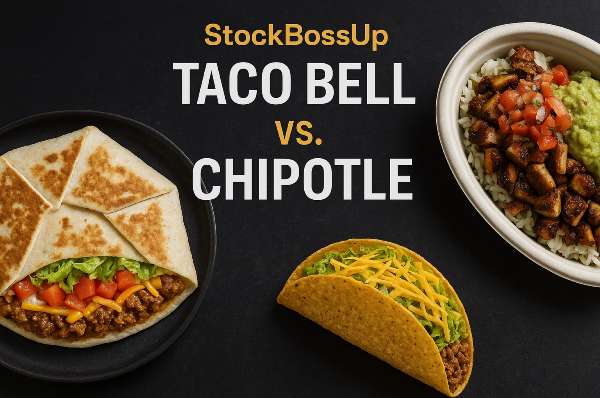
Chipotle is a giant in the restaurant industry, a brand that practically defines the fast‑casual category. But the real question investors are wrestling with right now is simple: Is Chipotle a buy today or a problem waiting to happen? The stock has been wobbling, sentiment has cooled, and performance has been murky. So we’re diving deep into everything that matters—from market share to margins to long‑term returns—to figure out whether Chipotle can bounce back or if the future looks as cloudy as its recent performance.
Welcome to the Food Fund. If you own Chipotle or you’re thinking about it, this breakdown is essential. We’re stripping away the noise and focusing on the fundamentals that actually move the stock.
Fundamentals
Let’s start with the hard truth. Chipotle’s stock performance over the last year? A disappointing –12% CAGR. But zoom out to five years and the picture flips dramatically: a 15% CAGR that shows long‑term strength and resilience. Chipotle has rewarded patient investors, and the numbers prove it.
One of the biggest catalysts for any restaurant stock is market share. Chipotle isn’t the largest restaurant company, but it’s growing steadily. Today, it holds 1.39% of the market share among public food, beverage, and restaurant stocks. That may sound small, but the trajectory matters. Over the last five years, Chipotle’s market share compounded at 9.45%, rising from 1.04% in 2021 to where it stands today. Growth has slowed recently, but the long‑term trend is undeniably upward.
Let’s talk fundamentals. Chipotle’s gross margin sits at a robust 40%, giving the company plenty of cushion if margin compression hits the industry. Revenue has grown at 13% annually over the past five years, reaching $11.58 billion. Growth has cooled, but $11.58 billion is still a massive number for a fast‑casual chain.
Cash flow tells an even better story. Operating cash flow improved at a 15% CAGR, while capex worsened at a 10% CAGR, resulting in free cash flow growing at a strong 17% CAGR over the last five years. Free cash flow is down slightly from 2024, but the long‑term trend remains positive.
Chipotle 5‑Year Growth Metrics
| Metric |
Value |
| Market Share (Today) |
1.39% |
| Market Share (2021) |
1.04% |
| Market Share CAGR |
9.45% |
| Revenue |
$11.58B |
| Revenue CAGR |
13% |
Share buybacks have also been a bright spot. Chipotle reduced its share count from 1.43 billion to 1.36 billion, a shareholder‑friendly move that increases ownership value over time. This is exactly what you want to see from a disciplined, well‑managed company.
Return on invested capital (ROIC) is another standout. Chipotle improved ROIC from 12.4% in 2021 to 19.3% most recently, showing that management is deploying capital more efficiently as the company matures. Operational efficiency is improving too: the cash conversion cycle moved from –4 days to –6 days, a small but meaningful improvement that signals tighter operations.
Debt is also trending in the right direction. Net debt to EBITDA fell from 2.3 in 2021 to 1.4, meaning Chipotle could theoretically pay off its debt in under a year and a half of earnings. As earnings grow, this ratio should continue to drift lower.
Chipotle vs. the S&P 500
Now let’s compare Chipotle to the gold standard: the S&P 500. If you invested $10,000 in Chipotle, it would have grown to $58,858, compared to $35,579 in the S&P 500. That’s an annualized return of 20.4% for Chipotle versus 14.3% for the index.
Chipotle does come with higher volatility and a larger maximum drawdown. Its Sharpe and Sortino ratios are slightly worse than the S&P 500, meaning the ride is bumpier. But the total return? Much stronger.
Chipotle vs. S&P 500 Performance
| Investment |
Ending Value |
Annualized Return |
| Chipotle |
$58,858 |
20.4% |
| S&P 500 |
$35,579 |
14.3% |
Chipotle outperforms the S&P 500 in total return, but it’s not a stock for the faint of heart. If you can stomach volatility, the long‑term reward has historically been worth it.
My Score
Chipotle, founded in 1993, is the undisputed leader in the fast‑casual restaurant space. With over 3,600 locations across the U.S. and growing international expansion, the company has built a powerful brand and a loyal customer base. But growth is slowing. The good news? The slowdown is industrywide, not a Chipotle‑specific failure.
As long as Chipotle maintains margins and continues to grow market share, it will be positioned for explosive growth once the economy strengthens. Based on the scoring system referenced in the transcript, Chipotle earns an 8 out of 10, placing it firmly within the “fundamental buy” range.
Before we move on, the transcript’s narrator reminds viewers to like, subscribe, and turn on notifications—classic YouTube energy—but the sentiment is clear: this is a company worth paying attention to.
Chipotle Fundamental Scorecard
| Category |
Value |
| Score |
8/10 |
| Gross Margin |
40% |
| ROIC |
19% |
| Cash Conversion Cycle |
–6 days |
| Net Debt / EBITDA |
1.4 |
Final Thoughts
Let’s lay out the final numbers the way the transcript does. Chipotle is a restaurant company with a 40% gross margin, a 14% five‑year revenue‑per‑share CAGR, and a 19% five‑year free‑cash‑flow‑per‑share CAGR. ROIC sits at 19%, the cash conversion cycle is –6 days, and net debt to EBITDA is 1.4—all strong indicators of a well‑run business.
But valuation is where things get tricky. Chipotle’s PEG ratio is 2.8, suggesting the stock is overvalued relative to expected earnings growth. Growth is slowing, and same‑store sales fell 4%, worse than the projected 2.9% decline. This marks the second consecutive contraction and the biggest since Q2 2020.
There is a silver lining: Chipotle reported a return to positive comparable sales and transactions in June. The company can weather an economic slowdown, but it’s not immune. Patience in the short term will likely be rewarded long‑term.
Chipotle Valuation & Sales Trends
| Metric |
Value |
| PEG Ratio |
2.8 |
| Same‑Store Sales |
–4% |
| Analyst Expectation |
–2.9% |
| Comparable Sales (June) |
Positive |
Chipotle remains a strong company—popular with consumers, respected by investors, and fundamentally sound. But the stock is no longer the runaway growth machine it once was. The question now is whether the current dip is a buying opportunity or a warning sign.
Verdict: Buy, Hold, or Sell?
Based strictly on the transcript’s data and tone:
Chipotle is a Hold.
The fundamentals are strong, the long‑term story is intact, but slowing growth and a high valuation make it difficult to justify aggressive buying at current levels. Patience appears to be the smart move.
If growth reaccelerates—or valuation cools—Chipotle could easily shift back into “Buy” territory.
https://youtu.be/82aTh8SHOQY?si=xf5k_Zkl40R0gDQO







Chipotle is a giant in the restaurant industry, a brand that practically defines the fast‑casual category. But the real question investors are wrestling with right now is simple: Is Chipotle a buy today or a problem waiting to happen? The stock has been wobbling, sentiment has cooled, and performance has been murky. So we’re diving deep into everything that matters—from market share to margins to long‑term returns—to figure out whether Chipotle can bounce back or if the future looks as cloudy as its recent performance.
Welcome to the Food Fund. If you own Chipotle or you’re thinking about it, this breakdown is essential. We’re stripping away the noise and focusing on the fundamentals that actually move the stock.
Fundamentals
Let’s start with the hard truth. Chipotle’s stock performance over the last year? A disappointing –12% CAGR. But zoom out to five years and the picture flips dramatically: a 15% CAGR that shows long‑term strength and resilience. Chipotle has rewarded patient investors, and the numbers prove it.
One of the biggest catalysts for any restaurant stock is market share. Chipotle isn’t the largest restaurant company, but it’s growing steadily. Today, it holds 1.39% of the market share among public food, beverage, and restaurant stocks. That may sound small, but the trajectory matters. Over the last five years, Chipotle’s market share compounded at 9.45%, rising from 1.04% in 2021 to where it stands today. Growth has slowed recently, but the long‑term trend is undeniably upward.
Let’s talk fundamentals. Chipotle’s gross margin sits at a robust 40%, giving the company plenty of cushion if margin compression hits the industry. Revenue has grown at 13% annually over the past five years, reaching $11.58 billion. Growth has cooled, but $11.58 billion is still a massive number for a fast‑casual chain.
Cash flow tells an even better story. Operating cash flow improved at a 15% CAGR, while capex worsened at a 10% CAGR, resulting in free cash flow growing at a strong 17% CAGR over the last five years. Free cash flow is down slightly from 2024, but the long‑term trend remains positive.
Chipotle 5‑Year Growth Metrics
Share buybacks have also been a bright spot. Chipotle reduced its share count from 1.43 billion to 1.36 billion, a shareholder‑friendly move that increases ownership value over time. This is exactly what you want to see from a disciplined, well‑managed company.
Return on invested capital (ROIC) is another standout. Chipotle improved ROIC from 12.4% in 2021 to 19.3% most recently, showing that management is deploying capital more efficiently as the company matures. Operational efficiency is improving too: the cash conversion cycle moved from –4 days to –6 days, a small but meaningful improvement that signals tighter operations.
Debt is also trending in the right direction. Net debt to EBITDA fell from 2.3 in 2021 to 1.4, meaning Chipotle could theoretically pay off its debt in under a year and a half of earnings. As earnings grow, this ratio should continue to drift lower.
Chipotle vs. the S&P 500
Now let’s compare Chipotle to the gold standard: the S&P 500. If you invested $10,000 in Chipotle, it would have grown to $58,858, compared to $35,579 in the S&P 500. That’s an annualized return of 20.4% for Chipotle versus 14.3% for the index.
Chipotle does come with higher volatility and a larger maximum drawdown. Its Sharpe and Sortino ratios are slightly worse than the S&P 500, meaning the ride is bumpier. But the total return? Much stronger.
Chipotle vs. S&P 500 Performance
Chipotle outperforms the S&P 500 in total return, but it’s not a stock for the faint of heart. If you can stomach volatility, the long‑term reward has historically been worth it.
My Score
Chipotle, founded in 1993, is the undisputed leader in the fast‑casual restaurant space. With over 3,600 locations across the U.S. and growing international expansion, the company has built a powerful brand and a loyal customer base. But growth is slowing. The good news? The slowdown is industrywide, not a Chipotle‑specific failure.
As long as Chipotle maintains margins and continues to grow market share, it will be positioned for explosive growth once the economy strengthens. Based on the scoring system referenced in the transcript, Chipotle earns an 8 out of 10, placing it firmly within the “fundamental buy” range.
Before we move on, the transcript’s narrator reminds viewers to like, subscribe, and turn on notifications—classic YouTube energy—but the sentiment is clear: this is a company worth paying attention to.
Chipotle Fundamental Scorecard
Final Thoughts
Let’s lay out the final numbers the way the transcript does. Chipotle is a restaurant company with a 40% gross margin, a 14% five‑year revenue‑per‑share CAGR, and a 19% five‑year free‑cash‑flow‑per‑share CAGR. ROIC sits at 19%, the cash conversion cycle is –6 days, and net debt to EBITDA is 1.4—all strong indicators of a well‑run business.
But valuation is where things get tricky. Chipotle’s PEG ratio is 2.8, suggesting the stock is overvalued relative to expected earnings growth. Growth is slowing, and same‑store sales fell 4%, worse than the projected 2.9% decline. This marks the second consecutive contraction and the biggest since Q2 2020.
There is a silver lining: Chipotle reported a return to positive comparable sales and transactions in June. The company can weather an economic slowdown, but it’s not immune. Patience in the short term will likely be rewarded long‑term.
Chipotle Valuation & Sales Trends
Chipotle remains a strong company—popular with consumers, respected by investors, and fundamentally sound. But the stock is no longer the runaway growth machine it once was. The question now is whether the current dip is a buying opportunity or a warning sign.
Verdict: Buy, Hold, or Sell?
Based strictly on the transcript’s data and tone:
Chipotle is a Hold.
The fundamentals are strong, the long‑term story is intact, but slowing growth and a high valuation make it difficult to justify aggressive buying at current levels. Patience appears to be the smart move.
If growth reaccelerates—or valuation cools—Chipotle could easily shift back into “Buy” territory.
https://youtu.be/82aTh8SHOQY?si=xf5k_Zkl40R0gDQO